
Losing a tooth can affect more than the appearance of your smile. A missing tooth can make chewing more difficult, change the way your teeth come together, and allow nearby teeth to gradually shift.
Two common ways to replace a missing tooth are a dental implant and a dental bridge. Both can restore the space left by a missing tooth, but they work in very different ways.
If you're considering your options, understanding the differences between a dental implant and a bridge can help you have a more informed conversation with your dentist.
What Is a Dental Implant?
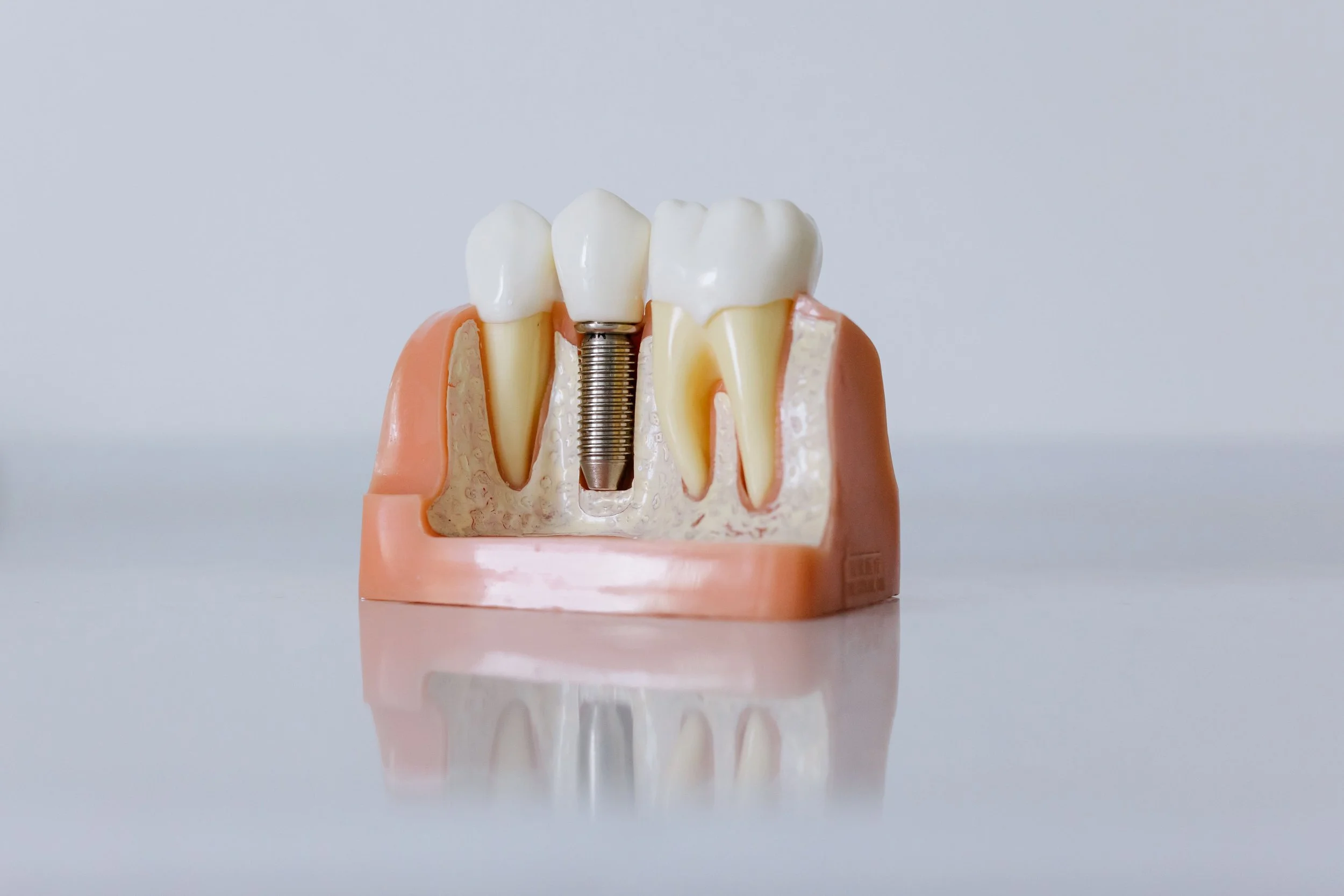
A dental implant replaces a missing tooth using a small post that is surgically placed into the jawbone. After the implant integrates with the surrounding bone, a restoration such as a dental crown is attached to create the visible portion of the replacement tooth.
Unlike a bridge, an implant does not rely on neighboring teeth for support.
Dental implants may be used to replace a single missing tooth, several teeth, or, as part of a larger treatment plan, an entire arch of teeth.
What Is a Dental Bridge?
A dental bridge literally "bridges" the space created by one or more missing teeth.
A traditional bridge generally consists of a replacement tooth supported by crowns placed on the natural teeth on either side of the gap. These neighboring teeth act as anchors for the bridge.
Because a bridge is fixed in place, it is not removed for daily cleaning like a removable denture.
Dental Implant vs. Bridge: What's the Main Difference?
The biggest difference is how the replacement tooth is supported.
A dental implant is supported by an implant placed in the jawbone. A traditional dental bridge uses neighboring teeth to support the replacement tooth.
This difference affects the treatment process, maintenance, cost, and the amount of time needed to complete treatment.
Do Dental Implants Affect the Teeth Next to Them?
One advantage of replacing a single tooth with an implant is that the neighboring healthy teeth generally do not need to be reshaped simply to support the replacement tooth.
With a traditional bridge, the teeth on either side of the missing tooth usually need to be prepared so crowns can be placed over them.
However, this doesn't automatically mean that an implant is appropriate for everyone. The condition of the neighboring teeth, gums, and jawbone all play a role in determining which treatment options may be suitable.
Which Option Takes Longer?
A dental bridge can often be completed more quickly because it does not require an implant to integrate with the jawbone.
Dental implant treatment usually takes longer. After an implant is placed, the surrounding bone generally needs time to heal and integrate with it before the final restoration can be completed. The exact timeline varies from patient to patient.
In some cases, additional procedures may also be necessary before implant placement.
How Long Do Dental Implants and Bridges Last?
Both dental implants and bridges are designed to be long-term tooth replacement solutions, but neither should be considered maintenance-free.
Their longevity can depend on factors such as:
Daily brushing and flossing
Regular dental examinations and cleanings
Teeth grinding or clenching
Smoking
Overall health
The amount of force placed on the restoration
A bridge also depends on the health of the teeth supporting it. Decay or gum problems involving an supporting tooth can affect the bridge.
With proper care, both options can provide many years of function.
Is It Easier to Clean a Dental Implant or a Bridge?
Both require excellent oral hygiene, but cleaning them is somewhat different.
A single dental implant can often be brushed similarly to a natural tooth, although your dentist may recommend additional cleaning techniques around the implant.
Because the replacement tooth in a traditional bridge is connected to the crowns beside it, floss cannot simply pass between the connected teeth. Special floss threaders, interdental brushes, or other cleaning tools may be recommended to clean underneath the bridge.
Whichever treatment you choose, keeping the surrounding gums healthy is extremely important.
What About Bone Loss After Losing a Tooth?
Natural tooth roots help stimulate the jawbone. After a tooth is lost, the bone in that area can gradually change over time.
Because a dental implant is placed within the jawbone, it can help provide stimulation to the bone in the area of the missing tooth.
A traditional bridge replaces the visible portion of the missing tooth but does not replace the tooth root.
This can be an important consideration when discussing long-term tooth replacement options with your dentist.
Which Costs More: A Dental Implant or a Bridge?
The cost depends on your individual treatment needs.
A dental implant may have a higher initial cost because treatment can involve implant placement, an abutment, and a final restoration. Additional procedures may sometimes be required as well.
A bridge may have a different upfront cost, but it is important to consider the entire treatment plan rather than comparing only the initial price.
Dental insurance coverage also varies. Your dental office can help you understand estimated costs and available benefits before treatment begins.
Am I a Candidate for a Dental Implant?
Not everyone is automatically a candidate for implant treatment.
Your dentist will need to evaluate factors such as:
The health of your gums
The condition and amount of available jawbone
The location of the missing tooth
Your overall oral health
Your medical history
Smoking or tobacco use
Your ability to maintain good oral hygiene
If there isn't enough bone to support an implant, additional treatment may sometimes be considered before implant placement.
When Might a Dental Bridge Be Considered?
A bridge may be considered when replacing one or more missing teeth, particularly when the neighboring teeth can appropriately support the restoration.
For example, if teeth next to the missing space already require crowns, incorporating them into a bridge may be one treatment option your dentist discusses with you.
For other patients, avoiding surgery or completing treatment within a shorter timeframe may also be considerations.
The appropriate choice depends on the condition of your mouth and your individual priorities.
What Happens If You Don't Replace a Missing Tooth?
Not every missing tooth presents the same situation, but leaving a space untreated can sometimes lead to changes over time.
Nearby teeth may begin shifting toward the empty space. The opposing tooth may also move because it no longer has a tooth to bite against.
Depending on where the tooth is missing, you may also experience changes in chewing or appearance.
That's why it's worthwhile to have the area evaluated even if the missing tooth isn't currently bothering you.
Dental Implant or Bridge: How Do You Decide?
There isn't one tooth replacement option that's right for everyone.
Your dentist can examine the missing-tooth area, evaluate the health of the surrounding teeth and gums, review X-rays or other imaging when necessary, and discuss the advantages and considerations of each treatment.
Factors such as oral health, available bone, treatment time, maintenance, cost, and personal preferences can all influence the decision.
Explore Your Tooth Replacement Options in Union City
If you're missing a tooth, you don't have to decide between a dental implant and bridge on your own.
At Union City Dental Aesthetics, we can evaluate your smile and explain the tooth replacement options that may be appropriate for your individual needs.
Whether you're missing one tooth or considering treatment for several missing teeth, the first step is understanding your options.
Contact Union City Dental Aesthetics to schedule a consultation and learn more about replacing missing teeth in Union City, California.